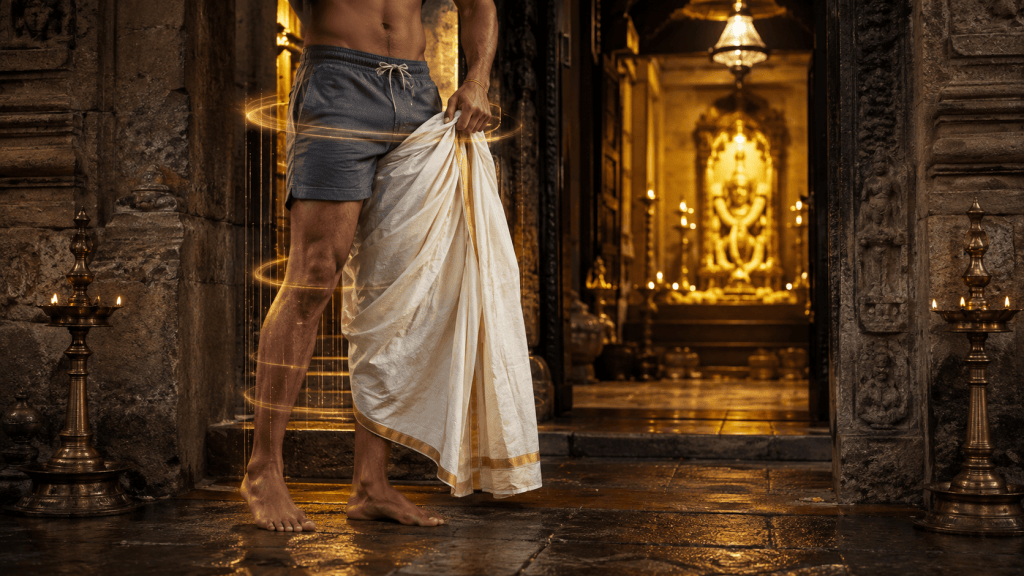
You arrive at a temple wearing shorts and someone at the entrance stops you.
“Full pants only.”
Most of us know the usual explanation. It is a temple, so dress respectfully. But that still leaves an obvious question. Why should an omnipresent Devata (deity) who supposedly sees every part of human life suddenly have a problem with your knees?
The traditional Tantric and Agamic answer is more interesting.
Shorts are not primarily unsuitable because the Devata is offended by exposed skin. Temple clothing is part of preparing the body to enter a Kshetra (consecrated sacred field). Long lower garments help ritually enclose and organise the lower body, which is associated with Apana Vayu (the downward-moving vital force).
However, the popular claim that “Prana leaks through exposed knees” goes too far. Traditional Yoga does not describe your knees as energy exhaust vents.
The real principle is ritual containment, not moral policing.
A Temple Is Not Simply a Building With a God Inside
A traditionally consecrated temple is very different from an ordinary hall where somebody has placed a statue.
Through Prana Pratishtha (ritual establishment of divine presence), mantra, ritual geometry, daily worship and other processes, the temple becomes a Kshetra (consecrated sacred field).
Think of the difference between walking through an office lobby and entering the server room of a data centre.
Both are rooms, but the second has been deliberately configured for a particular function. You do not walk into it with muddy shoes, coffee in your hand and start unplugging cables because you personally do not believe in server-room rules.
A traditional temple operates on a similar principle, except that the system being maintained is ritual rather than digital.
That is why temple traditions regulate things that may otherwise appear unrelated: footwear, cleanliness, food, behaviour, clothing and sometimes even who may enter particular parts of the temple.
The basic idea is simple.
Before your body enters a consecrated environment, the body itself is prepared.
Clothing is one part of that preparation.
So What Exactly Is Wrong With Shorts?
Tantra understands the human body in terms of different movements and concentrations of Prana (vital force).
One of these is Apana Vayu (downward-moving vital force), associated especially with the lower part of the body and functions such as elimination, reproduction and other downward-moving processes.
The pelvic region also contains the territories traditionally associated with Muladhara (root energy centre) and Svadhishthana (sacral energy centre).
Tantra does not consider these parts of the body dirty.
Quite the opposite.
They contain tremendous Shakti (power).
The question is not whether that power is good or bad. The question is whether it is ordered, contained and directed.
A traditional dhoti begins at the waist and continuously encloses the pelvic region, thighs, knees and most of the lower legs. The whole lower part of the body therefore sits within one ritual garment.
Shorts terminate halfway.
That does not mean Prana suddenly starts spraying out through your calves. It simply means the traditional ritual enclosure of the lower body is incomplete.
Does Prana Really Leak Through Your Knees?
Not in the simplistic way social media sometimes explains it.
Classical Hatha Yoga certainly teaches that Apana naturally moves downward. But when Yogis want to control that movement, they practise techniques such as Mula Bandha (root lock), not ankle-length trousers.
That distinction is important.
If fabric itself could prevent the loss of vital energy, Yogis would have saved themselves centuries of work learning Bandha (energetic locks), Mudra (energetic seals), Pranayama (regulation of breath and vital force) and Kumbhaka (breath retention).
So a dhoti is not a supernatural battery cover.
Its role is more ritual than mechanical.
Traditional ritual repeatedly uses boundaries. A Yantra (sacred geometric diagram) has boundaries. A Mandala (ritual sacred space) has boundaries. A Kavacha (protective ritual armour) creates a boundary around the practitioner. Digbandhana (ritual sealing of the directions) establishes the boundary of a sacred working space.
The temple itself is constructed through layers of enclosure.
Vastra (ritual clothing) follows the same broad logic on the human body.
Then Why Can Men Be Bare-Chested in Some Temples?
This is where the idea that temple dress codes are simply about modesty starts falling apart.
Some of India’s most orthodox temple traditions require men to wear a long dhoti or mundu while leaving the upper torso uncovered. Kerala’s Sree Padmanabhaswamy Temple is a famous example.
Think about what that means.
If exposed skin itself were spiritually inappropriate, a bare chest should be a bigger problem than a visible knee.
But it isn’t.
The traditional configuration is specifically different above and below the waist.
The lower generative and Apanic region is enclosed, while the upper body may remain uncovered according to that temple’s ritual tradition.
This does not prove that every temple dress code was consciously designed around subtle-body anatomy. Regional custom, social ideas of modesty and historical practice have also shaped temple clothing.
But it does show that “God does not like exposed skin” cannot explain the whole system.
Why a Dhoti Instead of Full-Length Jeans?
Full-length jeans are obviously better suited to a temple than shorts if the question is simply coverage.
But a dhoti carries additional ritual meaning.
Traditional garments such as the dhoti, mundu and sari are wrapped as continuous pieces of cloth rather than being tailored tightly around individual parts of the body. That continuity fits naturally with the ritual principle of Akhandata (unbroken wholeness).
This does not make stitched clothing spiritually bad.
Your jeans are perfectly useful for everyday life.
A dhoti simply belongs more naturally to a ritual environment.
Think of it like gym clothing. You can technically exercise wearing formal trousers, but nobody would argue that a business suit and training clothes are equally suited to the job merely because both cover the body.
Ritual also has clothing designed for its function.
But Why Are the Feet Left Bare?
This is another clue that temple clothing was never about sealing every inch of skin.
If the goal were literally to prevent energy from escaping through the lower body, shoes and socks should be compulsory.
Instead, almost every Hindu temple asks you to remove them.
Your feet remain directly in contact with the temple floor and sacred precinct.
So the traditional configuration is not:
Cover everything to stop energy loss.
It is:
Enclose some parts of the ritual body while allowing other parts to interact directly with the sacred field.
Your eyes receive Darshana (sacred sight of the deity). Your ears receive mantra and bells. Your forehead may receive Kumkum (sacred vermilion), Bhasma (sacred ash) or Tilaka (sacred mark). Your hands receive Prasada (consecrated offering).
The temple is not shutting down sensory interaction.
It is redirecting it.
What If You Visit a Temple Wearing Shorts?
If the temple permits shorts and you happened to visit spontaneously, there is no reason to panic.
Your aura has not developed a puncture.
The Devata is not sitting inside the sanctum judging your kneecaps.
But when you know you are visiting a temple, clean full-length clothing is the better choice. Where a particular temple prescribes a dhoti, sari, mundu or another traditional garment, follow its Maryada (ritual discipline and boundary).
There is also a larger point here.
You could enter a temple wearing the purest white dhoti available while checking WhatsApp, discussing office politics, looking at other people and mentally planning dinner.
Someone else may enter wearing ordinary trousers, switch off his phone, become silent and mentally repeat the mantra of his Ishta Devata (chosen deity).
The second person may be far more inwardly prepared for Darshana (sacred encounter).
Clothing matters.
But Chitta (mind and attention) matters far more.
So Why Are Shorts Traditionally Avoided?
Not because Hindu gods have a problem with knees.
Not because exposed calves automatically leak Prana.
And not simply because ancient Hindus were obsessed with modesty.
Traditional temple clothing belongs to a larger ritual technology in which the body is prepared before entering a consecrated field. The long lower garment helps create a defined enclosure around the Apanic and generative region, while traditional clothing also marks the transition from ordinary life into sacred space.
That is the principle worth remembering.
When a temple asks you to dress differently, it is not necessarily saying:
“Cover yourself because God is watching.”
It is saying something far more interesting:
“You are entering a space that has been ritually prepared. Prepare yourself too.”