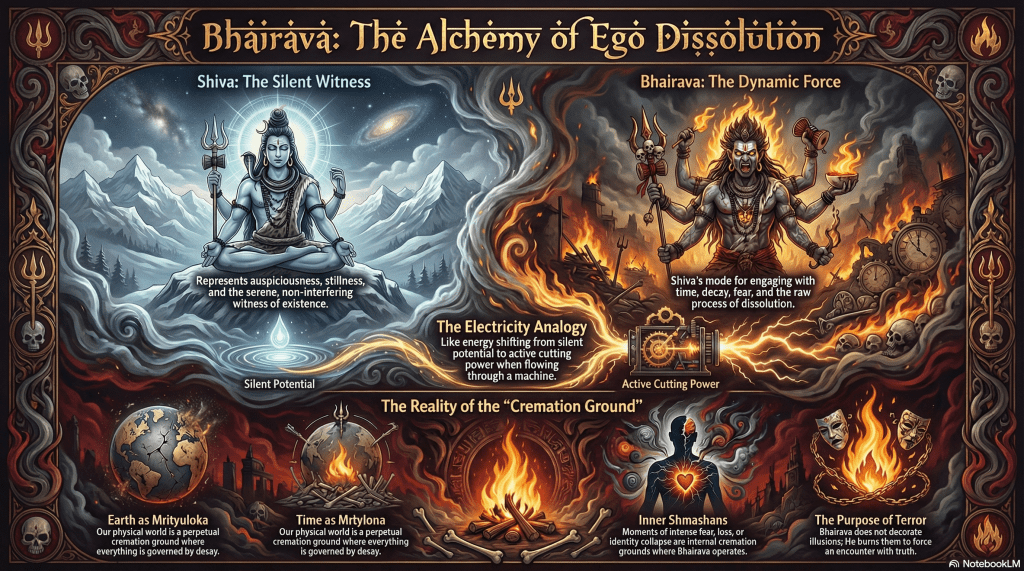
You must have often heard the line “Shiva becomes Bhairava when he steps inside the cremation ground. And when he steps outside, he becomes Shiva again. This Earth itself is a cremation ground, Mrityuloka.”
If you’ve heard this line and paused, you’re not alone. It sounds poetic, maybe even dramatic. But from a Tantric lens, it’s not poetry. It’s operating system level truth.
Let’s understand how.
First, understand this clearly: Shiva and Bhairava are not two different gods. They are two modes of the same Consciousness.
Shiva, in the way most people understand Him, is auspiciousness and stillness. The serene yogi sitting on Kailasa. The silent, non-interfering witness.
Bhairava is that same Shiva when He turns toward what the world avoids – death, decay, fear, blood, transgression, taboo, and psychological darkness. The uncomfortable truths of existence.
So what does it mean when we say Shiva becomes Bhairava in the cremation ground?
It means when Pure Consciousness steps into the raw field of death and impermanence, it cannot remain in a “polite” form. It must become the force that can digest death. That force is Bhairava.
Now let’s talk about the cremation ground.
Most people think of a physical shmashan. Fire, ash, melting flesh, pungent smoke, and silence. A body being reduced to nothing. That image is important. Because the cremation ground is the one place where every illusion collapses.
In a temple, you can still pretend.
Pretend you’re in control.
Pretend your identity is permanent.
Pretend your relationships are forever.
Pretend your achievements define you.
In a cremation ground, none of that survives.
The CEO, the struggler, the influencer, the saint, the sinner. All become ash. Bhasma.
Tantra says: if you want truth, go where lies cannot survive.
That is why Bhairava is called the Lord of Time, Death, and Terror. Not because He is negative. But because He rules the domain where ego cannot hide.
This Earth is called Mrityuloka. The realm of death.
Everything here is under the law of decay. Your body is aging as you read this. Your parents are aging. Your children are growing and changing. Relationships shift. Careers rise and fall. Health fluctuates. Nothing here is stable.
You may not physically be sitting in a cremation ground. But existentially, you are.
This entire plane runs on the principle of impermanence. That is what makes it a cremation ground in perpetuity.
So if this realm itself is a shmashan, which form of Shiva operates here? Bhairava. Because only Bhairava can stand inside impermanence without flinching.
Let’s bring this closer to home.
Every time you experience intense fear, you are in a cremation ground. Every time a relationship ends, you are in a cremation ground. Every time your self-image shatters, you are in a cremation ground. And, every time addiction grips you, shame surfaces, rage erupts, or identity collapses, you are standing amidst burning wood and ash.
These are inner cremation grounds.
And when Shiva enters these spaces within you, He does not appear as the calm Himalayan yogi. He appears as Bhairava. Sharp, direct, surgical.
This is why Bhairava upasana is not casual. He does not decorate your illusions, He burns them.
Bhairava will disrupt what you thought was stable. He will expose hypocrisy. He will force you to confront attachments you swore were “harmless.” He will strip away comfort structures you were hiding behind.
To the ego (your I-ness), this feels like destruction. But to a Bhairava upasaka, this is purification.
Understand this: Shiva, in His pure form, is absolute stillness. Beyond creation, beyond dissolution. Untouched, unmoved.
But when that stillness engages with Time, with decay, with the raw process of life and death, it becomes dynamic, fierce, transformative. That dynamic face is Bhairava.
Think of electricity. In its true form, it is silent energy. Neutral, pure. But when it flows through a machine designed to cut metal, it becomes cutting power. The energy did not change. Its expression did.
Similarly, Shiva does not “turn into” someone else. He just shifts His mode based on the realm He is operating in.
In the field of auspicious creation and harmony, He is Shiva. In the field of dissolution and ego death, He is Bhairava.
Now reflect on your own life.
When everything is going well, you pray to Shiva for blessings. When life collapses, when fear grips your chest at 2 AM, when you feel exposed and alone, when your old identity is dying, that is not a Shiva temple moment. That is a cremation ground moment.
And in that moment, it is Bhairava who stands with you.
Not to console you with sweet words. But to make sure you do not run from transformation.
This is also why Tantra does not romanticize life. It does not say the world is a playground. It says the world is a cremation ground. Not to depress you. But to make you serious.
If everything here is temporary, what are you clinging to?
If every identity ends, who are you really?
If every body burns, what is the point of ego obsession?
Bhairava sadhana is all about becoming fearless in a realm ruled by death.
It is about learning to die before you physically die. To let the ego burn while you are still breathing.
Because the one who has died consciously cannot be threatened by change.
And when the burning is complete, what remains?
Silence. Stillness. Auspiciousness. Shiva!
Recognize that you are already living in the cremation ground called Earth.
Stop expecting permanence from an impermanent plane. Stop demanding comfort from a realm governed by Time. Instead, align with the Lord of this field.
Call Him Shiva when you seek stillness. Call Him Bhairava when you stand amidst burning identities.
And understand this deeply. He never left the cremation ground. We did. In denial.
The moment you drop the denial and accept impermanence as the rule of this world, Bhairava stops being frightening.
He becomes protection. He becomes clarity. He becomes the fierce compassion that refuses to let you waste this lifetime in illusion.
And that is the real meaning of Shiva becoming Bhairava in the cremation ground. Not a change in deity, but a change in how much truth you are ready to face.




 Sadhana Secrets