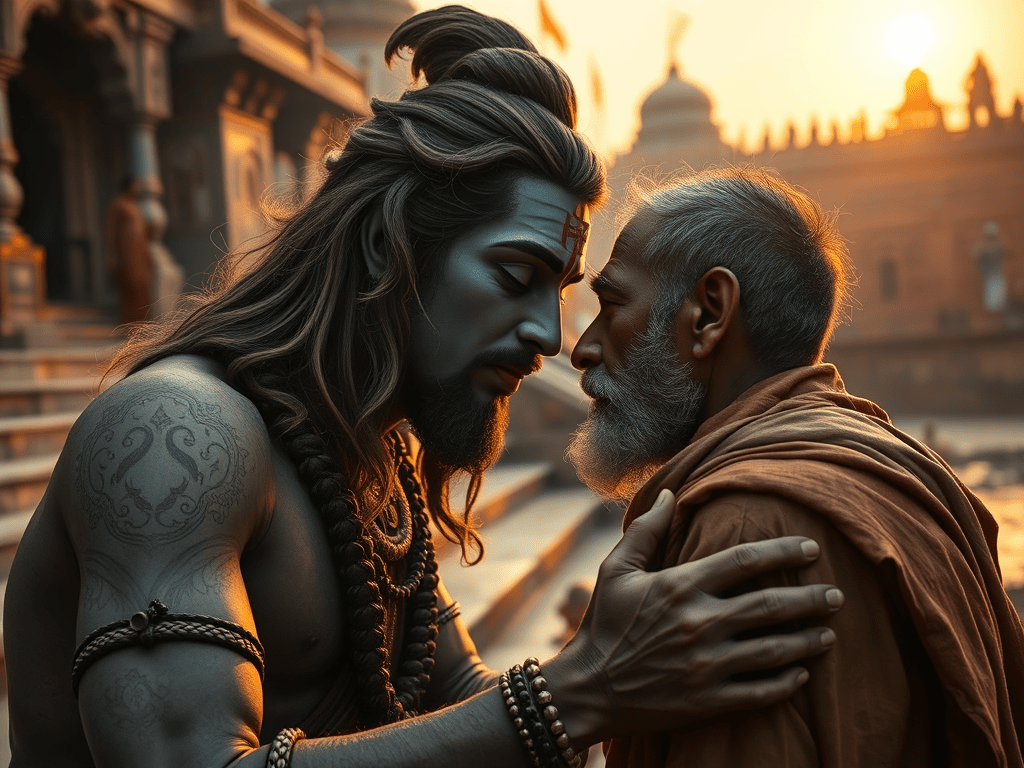
If you are in sadhana marga, I’m sure you must have heard a hundred times that “When someone dies in Kashi, Lord Shiva himself whispers ‘Rama’ in their ear.”
Sounds poetic, right? Unfortunately, most people take it literally. Like Lord Shiva with his matted hair bending down like a nurse in an ICU, whispering “Ram” softly into someone’s ear.
Nope. That’s not how it works. Here’s why:
1. What Really Happens in Kashi?
Kashi (Varanasi / Banaras) isn’t just another Indian city. It’s a cosmic departure lounge itself where the soul checks out of the body and boards its next flight.
It’s in Kashi they say that Lord Shiva gives you the Rama Taraka Mantra that helps you cross the ocean of birth and death.
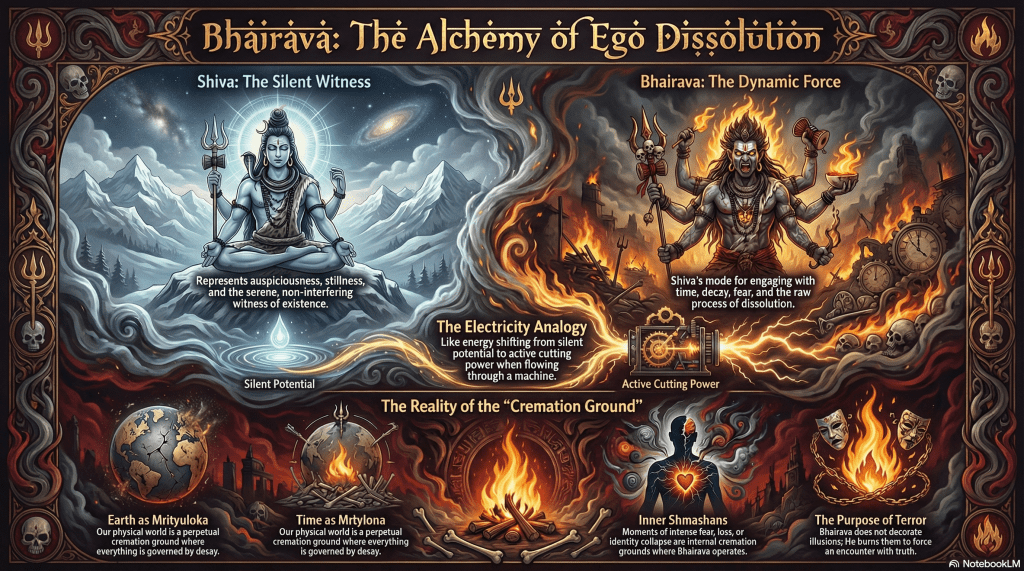
But Shiva here isn’t the blue-throated yogi from Pinterest wallpapers. In Kashi, he is Kalabhairava, the embodiment of time itself, standing guard at the border between this world and the next.
When the prana (last breath) leaves the body, the deceased’s energy merges into Bhairava’s field. That merging creates a sound of an inner resonance.
This sound is “Shiva’s whisper.”
The dying person doesn’t hear it with his ears; his soul does. It’s not a spoken voice, it’s a deep vibration that makes the dying person forget his body, his mind, his whole identity game.
That vibration is the Rama Nama.
Which “Rama” Are We Talking About Exactly?
In the context of Kashi, Rama isn’t necessarily Prabhu Shri Ram, the prince of Ayodhya.
In Sanskrit, ram means “to rest, to delight, to dwell.”
In this case, Rama means that in which Consciousness rests in bliss.
Simply put, this Rama isn’t human; he’s the state where even gods take a break. The infinite awareness in which both Shiva and Vishnu dissolve.
That’s why even Lord Shiva invokes it, because this “Rama” isn’t smaller than him; it’s the very vibration of the Ultimate itself.
Why “Rama Nama” Has Such Power
The word “Rama” is made of two syllables: “Ra” and “Ma”.
“Ra” is the Agni (fire) that burns your karma, all the unnecessary junk data in your system.
“Ma” is the moonlight that cools you down, integrates what’s left.
When fire and moonlight meet, you get balance, the perfect reboot.
That balance is what we call Moksha.
That’s why even Shiva chants it. Because “Rama” is not mere devotion, it’s the ultimate vibration of freedom.
What “Shiva Whispering” Actually Means
In Kashi, every vibe is Bhairava. The city is one massive, living, breathing mantra.
So when a person dies there, his personal energy syncs with that field.
That’s when the Rama Taraka vibration awakens, an inner sound that unplugs the soul from the matrix.
So, “Shiva whispers” doesn’t mean a god talking into your ear.
It means your own higher consciousness, the Bhairava within, triggers the final “log out.”
Think of it this way: in life, your Guru gives you a mantra in your ear to awaken you.
In death, Shiva – the Adi Guru – gives you one last initiation: the Rama Taraka Nama.
That makes Kashi a 24×7 initiation zone. The entire city hums with that frequency. Every brick, every gust of wind is saying, “Rama”
That’s why dying in Kashi isn’t considered “the end”, it’s graduation day.
Want to feel even a glimpse of what that final “whisper” is like? Try this:
Sit quietly.
Inhale deep, and in your mind say “Ra”. Feel the fire rise from your navel.
Now exhale softly with “Mmm.” Let that hum cool your head like moonlight.
When fire and moonlight meet, that still point of silence, that’s the real Kashi.
That’s the whisper of Shiva. And in that silence, the soul smiles.



 Sadhana Secrets